Tuesday, July 26, 2011

Amazing Office Designs

If you've seen the movie "Office Space" you'd get a sense at how tedious working in an office can be. But for some people, the office is a second home... so why not make it as comfortable as possible? In this post we'll see some amazing office designs, built to ignite the architectural senses.

TBWA Hakuhodo Offices
The problem with the office is that you can be couped up inside when it's such a beautiful day outside. A Tokoyo Ad Agency thought about this and decided to bring the outside inside. Complete with garden, grass lawn and driving range, this ex-bowling alley has been converted to make the indoor environment replicate the outdoor.
Penthouse Offices by Benthem Crouwel Architects
Hovering above the Las Palmas building in Rotterdam, Netherlands, the Penthouse Offices showcase a large curved glass window facing out to the river. The interior is furnished with wood furniture and sleek white walls that create an open space, allowing for a smooth enclosed design.
Manchester Square Interior
The goal by SHH was to make this office feel more like a gentlemen's club. Spanning five stories in a Georgian townhouse in London's West End, these offices are a mixture of work and play. The furniture has been designed for comfort while the interior still attempts to hold faithful a mixture of Victorian and contemporary elements.
White Mountain Office
With a look straight from a James Bond movie, this spectacular office sits buried beneath the city of Stockholm. Once used as an anti-atomic bomb shelter, the space has been expertly converted to house one of Sweden's top ISP companies. Complete with a floating conference room, a secret stone entrance and the ability to protect whoever's inside from nuclear fallout, the White Mountain office would easily be on the property shopping list of any would-be Bond villain!

Tuesday, July 12, 2011

Will the Carbon Tax directly affect housing affordability?

The deadline date for the introduction of the Carbon Dioxide Tax is scheduled for July 2012, up until that time there will be much speculating on what the impending tax will do to the housing market. The majority of economists agree that the Cardon Tax will lead to a 0.7 per cent increase to inflation which will undoubtedly catch the eye of the RBA, who would consider raising interest rates to combat the rise. The National Australia Bank is forecasting two rate rises in the next year, one in late 2011 and one in May 2012 just before the Carbon Tax is brought in. While an initial 0.7 per cent inflation rise is considered a minimal impact, some economists like JPMorgan Stephen Walters believe there may be unforeseen economic aftershocks once the tax is introduced: "If we see electricity prices go up by 5 per cent rather than 3 per cent forecast, the unions are going to start to push for higher wages in addition to the compensation on offers. That is a clear second-round effect and that is when it becomes material."

The housing sector too is worried about how the Carbon Dioxide Tax will effect housing affordability. The Housing Industry Association - a body representing builders and suppliers of building products is arguing that the Carbon Tax will add an additional $5000 to $6000 to the cost of a new house and land package. This cost will of course be passed on to the customer which has the further potential to discourage home buyers from building their new home. "Increases in the cost of construction materials including bricks, steel and aluminium will be simply passed on to purchasers, pushing the price of new housing higher," REINSW President Wayne Stewart said, "the knock-on effect of this could see the median Sydney house pushed out of the reach of many prospective home buyers."

However, not all economists think that housing will be adversely affected by the Carbon Tax. Tony Wood of The Grattan Institute says, "Whenever industry is given the incentive, it finds ways to do things that cost less than any economist can ever think of." Some industries like aluminum, steel and cement, he argues, will be compensated under the current Carbon Tax scheme. "They should not be allowed just to put their prices up and pass through a carbon price they're not paying for."

What are your thoughts? Do you think the Carbon Tax will directly impact and hurt housing affordability in Australia? Put your comments below.

Tuesday, July 5, 2011

Support our team in the Oxfam Trailwalk

Picture this challenge: you must run continuously for 17 hours over rugged, precarious and mountainous terrain to reach your goal 100 kilometres away. Could you do it?

That is what our team at aboutlife...100 are attempting to do to raise funds and awareness in the fight against global poverty. The four person team, which includes our super Sales Agent Lynsey Kemp, our sensational Property Management Administrator Mary Tuka, Terry Tyrell Business Development Manager at Russell Investments and Joel Aurisch part owner of AboutLife Supermarket, are participating in the Oxfam Trailwalker.

It is a 100km track that runs from the Hawkesbury district to Sydney through dense bushland and hilly coastal terrain. It runs from 26th August to 28th August and is an extremely gruelling track even for walkers!
And our team is running it!
And they need your donations!

Help support the team as they train their guts out for one of the toughest tests this year. The goal for the team is to raise $10,000 for Oxfam which will aid the organisation by contributing to long-term development and positive change in needy communities around the globe. To show your support you can donate money to the aboutlife...100 team or join the Sarah Lorden Real Estate team at our fundraising Oxfam stall on Saturday 16th July at Loyalty Square, Balmain.

We will be holding a BBQ at the Oxfam stall with sausage sandwiches dripping in delicious fat, just to tempt the aboutlife...100 team and their insanely fit members!

Tuesday, June 21, 2011

The Man-Cave

The Den, the Shed, the Cubby. Call it what you want, over the last few years we have see the popularity of these "havens of manliness" grow and grow. Once upon a time these venues of virilaty went by the name of the shed or the garage, a place where men could be men and pursue their passions. Some men will claim that it is a place for them to take some time out from the "ol ball-and-chain", others will say that it is a place for him and his buddies, but really its just a place where boys can play with their toys.
And what toys some boys have! In this post is just a small collection of some fantastic Temples to Manliness!

The Sports Man-Cave
Sport is a way of life for a man. If you don't enjoy the competition and the smell of other sweaty men, then you are just not a man!

The Golf Man-Cave
There are many women out there who know curse the day their husband took up golf. It was the day they became known as a "golf widow" but with the Golf Man-Cave, the hubby will always be at home, slicing shots into computer generated woods and putting around the vacuum cleaner to win the Home-bound PGA!

The Nightclub Man-Cave
What man hasn't wanted to turn his humble garage into an asylum for alcohol? This man-cave is worth charging an entry fee for!

Serial Killer Man-Cave
When your man's obsession with guns spills over into a converted bunker, you'd have to wonder if he is really worth keeping. The big brass vault door is to keep him locked in there until he's run out of ammunition... about 4 weeks!

Thursday, June 9, 2011

"The Anchorage" - 44 Louisa Road, Birchgrove

Having written about the rich history of "Birch Grove House", Australia's second oldest home, in a previous blog, I thought I would talk about another home still standing in Louisa Road that sits literally across the street from where the old Birch Grove House once stood. 44 Louisa Road - The Anchorage.

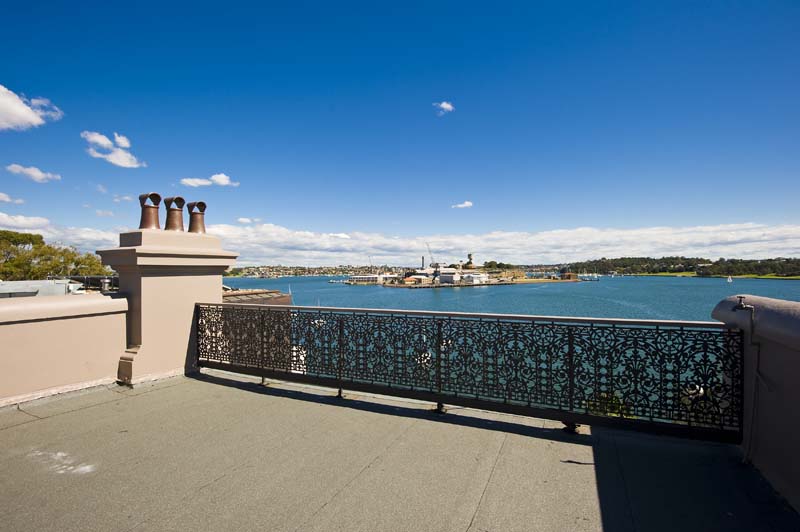
Standing to be what some claim as the tallest home on the Balmain peninsula, "The Anchorage" at 44 Louisa Road, Birchgrove was built in 1896 by John Gibson. Gibson was the inaugural occupant of the home and was, according to the State Library of NSW, the chief Engineer of the Cockatoo Island Dockyard. Previously known as "Fitzroy Villa" and built in the Italianate style, The Anchorage, has a unique feature - a Widow's Walk situated at the top of the flat roof, towering over the homes of Louisa Road.

Back in the early days of Birchgrove, there used to be a coal mine situated in the spot where Birchgrove Public School now stands. This was the first coal mine in Australia and once the coal was brought to the surface, it was placed on to railed trolleys that ran to a nearby wharf and shipped away. The Widow's Walk (or Captain's Walk) at 44 Louisa Road, played an important role in providing an over watch look out for the shipping lanes to and from the coal mine, as well as, a clear line of sight to Gibson's Dockyards at Cockatoo Island.

While the original architectural plans for the home still survive at the State Library of NSW in linen and paper, the home has recently been restored to its former charm but with modern amenities. Currently up for sale with Kate Lorden of Sarah Lorden Real Estate, the home is five levels of large rooms, all with spectacular waterfront views. It has its own private jetty, pool and the Widow's Walk is perfect for entertaining or watching the boats sail by.

You are invited to view the home at its first open house this Saturday 11th June 2011 between 12.00 - 12.45pm. It is an amazing piece of Australian heritage in Birchgrove's most exclusive street.

Tuesday, May 17, 2011

Some Amazing Underground Homes

With all the talk in Sydney about the need for high density living, developers and politicians have immediately turned to the high rise skyscraper unit blocks to solve the housing problem. But what about building beneath the surface, in an underground home? Visually stunning and often extremely ecco-friendly here are a couple of amazing underground homes that catch the eye.


Swiss Mountain Ellipse
In the Swiss mountain village of Vals, sits a sunken crater that is barely visible from the surface. For an underground home, it offers spectacular mountain views.
More Photos


Gary Nevilles Home
Former Manchester United Star Gary Neville has recently had plans drawn up for an amazing home that looks like something out of the teletubbies. Built almost entirely underground, the home has been designed into the shape of a flower with each of the petals representing the activities of "work", "entertain", "eat", "relax" and "play" with the kitchen as the central focal point in the middle.
Said to cost 8 million pounds to build, the home has a 0% carbon footprint and generates its power from a wind turbine, solar panels and an underground thermal heating system. In fact, the home is thought to be so efficient that the UK Government has set it as the benchmark for zero carbon emission design.
The architects of the building have used the ancient neolithic settlement of Skara Brae as inspiration for the design.

Uunderground cities of Kaymakli & Derinkuyu
Living underground is not a new concept. The inhabitants of Cappadocia in Turkey built dwellings into the soft volcanic rock. There is evidence that they housed persecuted Christians during the Roman and Byzantine eras and some of the structures are as tall as 11 stories. At their height, these stone cities would have been able to accommodate up to 50 000 people and large stone boulders were rolled in and out as doors to seal the community away from the persecuting outside world.

Tuesday, May 3, 2011

Bushrangers in Balmain - Captain Thunderbolt

The folklore of bushrangers have touched the hearts and minds of all Australians. Their romantically rogue ways of highway robbery and living a life on the run have become legend in Australian history. Balmain, more specifically, Cockatoo Island became an island known for housing some of Australia's most notorious bushrangers. In 1857, a local newspaper called Cockatoo Island "a hot bed of vice, a nursery of crime and a den of the blackest infamy where crimes that would rise the blush of burning shame upon a demon's check are nightly perpetrated." After that description, no one could mistake Cockatoo Island for being a nice place!

In 1833, Governor Bourke established a gaol on the island that originally housed 250 convicts. The island, situated in a remote part of Sydney and surrounded by strong tides and currents, made for a perfect fortress to hold the derelicts of society. It stood as a goal for 38 years before being shut down. During that time, the gaol housed the famous bushranger - Captain Thunderbolt. Captain Thunderbolt gained notoriety as being one of the few prisoners to escape Cockatoo Island prison, braving the strong currents to set foot in Balmain.

Born with the name Frederick Ward in 1833 to convict parents in Wilburforce, Ward was originally sentenced to 10 years hard labour at Cockatoo Island for selling 75 stolen horses. He was 23 at the time. After serving 4 years on the island, he was released and married Mary Ann Bugg. In 1860, he was sent back to Cockatoo Island for stealing 2 shoes and a horse. His wife devised a plan to break him out of gaol.

On 11 September 1863, Mary Ann Bugg swam from the cliffs at Birchgrove to Cockatoo Island carrying tools to release her husband. The plan was a success with Ward, his wife Mary Ann and another prisoner, Fred Bitten, escaping Cockatoo Island and successfully swimming the narrow water ways to the Balmain Peninsular.

The trio then made their way north to the Hunter Valley region where they soon became notorious bushrangers committing crimes ranging from highway robbery to horse stealing. Their crimes were so quick, yet brutal that Ward quickly earned the name Captain Thunderbolt.

Captain Thunderbolt terrorised the NSW central north west for 7 years until he suddenly disappeared. There are a few theories about what happened him. One theory is that he was shot during a highway robbery in 1870 by a Constable Walker in Uralla; however the locals at the time maintained that it was Ward's uncle who was killed and not Captain Thunderbolt. Another theory was that he had fled to America where a "Frederick Ward" shows up in an American census in 1871.

Captain Thunderbolt's violent legacy remains with a statue to him in Uralla and at the Moonan Flat Pub in Scone, where there still remains a bullet hole in the wall made by the bushranger during a hold up.